what techniques are used to obtain an accurate reading of public opinion
Constructing Public Opinion Surveys
An opinion poll is a survey of public stance from a item sample, and is designed to represent the opinions of a population.
Learning Objectives
Hash out how public opinions surveys are designed and executed
Key Takeaways
Key Points
- There are several ways of administering a survey, such as phone, mail, online surveys, personal in-dwelling surveys, personal mail or street intercept survey, and hybrids of the higher up.
- A survey typically consists of a number of questions the respondent answers in a set format. At that place are open up-ended and airtight-ended questions. An open-concluded question asks the respondent to grade their own answer, while closed-ended questions have the respondent choose an respond from a given option.
- The nearly of import aspects of a survey include identifying and selecting potential sample members, contacting individuals and collecting data from those who are difficult to reach, evaluating and testing questions, and selecting the mode for posing questions and collecting responses.
Key Terms
- Opinion Poll: An opinion poll, sometimes simply referred to equally a "poll," is a survey of public stance from a particular sample. Opinion polls are usually designed to represent the opinions of a population by conducting a series of questions and and then extrapolating generalities in ratio or within confidence intervals.
- Self-Selection Bias: Although individuals chosen to participate in surveys are often randomly sampled, errors due to not-response may be. Some prospective respondents may simply be less probable to respond to polls by and large, they may non exist interested in the subject field, or they may be unreachable for a diversity of reasons.
An opinion poll, sometimes simply referred to as a "poll," is a survey of public opinion from a particular sample. Opinion polls are usually designed to stand for the opinions of a population past conducting a series of questions and so extrapolating generalities in ratio or within confidence intervals.

Voter Poll: Voter polling questionnaire on brandish at the Smithsonian Institution
Modes of Information Collection
There are several means of administering a survey. The pick betwixt administration modes is influenced past: one) price, 2) coverage of target population, 3) flexibility of request questions, 4) respondents' willingness to participate, and 5) response accurateness. Unlike methods create mode effects that modify how respondents reply. The most common modes of administration are:
- Telephone
- Post
- Online surveys
- Personal in-dwelling house surveys
- Personal mall or street intercept surveys
- Hybrids of the above.
Response Formats
Usually, a survey consists of a number of questions the respondent answers in a gear up format. A stardom is made betwixt open-ended and closed-ended questions. An open-ended question asks the respondent to formulate his or her own answer, while closed-ended questions take the respondent choose an respond from a given number of options. The response options for a closed-ended question should be exhaustive and mutually exclusive. The four types of response scales for airtight-concluded questions are:
- Dichotomous: The respondent has ii options.
- Nominal-polytomous: The respondent has more than two unordered options.
- Ordinal-polytomous: The respondent has more than two ordered options.
- (Bounded) Continuous: The respondent is presented with a continuous scale.
A respondent's reply to an open-ended question tin be coded into a response scale afterwards or analyzed using more qualitative methods.
Survey Methodology
The most important aspects of a survey include:
- Identifying and selecting potential sample members.
- Contacting individuals and collecting data from those who are hard to reach (or reluctant to respond).
- Evaluating and testing questions.
- Selecting the fashion for posing questions and collecting responses.
- Preparation and supervising interviewers.
- Checking data files for accuracy and internal consistency.
- Adjusting survey estimates to right for identified errors.
Advantages
- They are relatively easy to administer.
- Can be developed in less fourth dimension compared with other information-collection methods.
- Can exist cost-effective.
- Few "experts" are required to develop a survey, which may well increment the reliability of the survey data.
- If conducted remotely, tin can reduce or obviate geographical dependence.
- Useful in describing the characteristics of a big population bold the sampling is valid.
- Can be administered remotely via the Web, mail, e-postal service, telephone, etc.
- Efficient at collecting information from a large number of respondents.
- Statistical techniques can be applied to the survey data to determine validity, reliability, and statistical significance, fifty-fifty when analyzing multiple variables.
- Many questions can be asked most a given topic, giving considerable flexibility to the analysis.
- A wide range of information tin can be collected (e.yard., attitudes, values, beliefs, and behavior).
- Considering they are standardized, they are relatively gratis from several types of errors.
Disadvantages
The reliability of survey data may depend on the post-obit:
- Respondents' motivation, honesty, memory, and ability to respond:
- Structured surveys, specially those with closed-ended questions, may have low validity when researching constructive variables.
- Cocky-option bias: Although the individuals chosen to participate in surveys are often randomly sampled, errors due to non-responses may exist. Some prospective respondents may merely be less likely to reply to polls more often than not, non interested in the field of study, or may be unreachable for many reasons. For example, polls or surveys that are conducted past calling a random sample of publicly bachelor telephone numbers will not include the responses of people with unlisted telephone numbers, cell telephone numbers, who are unable to answer the phone, and who do not reply calls from unknown/unfamiliar telephone numbers.
- Question design: Survey question answer-choices could atomic number 82 to vague data sets because, at times, they are relative merely to a personal abstruse notion apropos "strength of choice". For example, the choice "moderately agree" may mean different things to dissimilar subjects and anyone interpreting the data for correlation. Even "yes" or "no" answers are problematic because subjects may for example put "no" if the choice "only in one case" is not bachelor.
Non-response Reduction
The following means take been recommended for reducing non-response in telephone and confront-to-face surveys:
- Accelerate letter: A short letter sent in advance to inform the sampled respondents about the upcoming survey.
- Preparation: The interviewers are thoroughly trained in how to ask respondents questions, piece of work with computers and make schedules for callbacks to respondents who were non reached.
- Short introduction: The interviewer gives the basic data on him/herself and the survey.
- Respondent-friendly survey questionnaire: Questions must exist clear, not-offensive, and like shooting fish in a barrel to respond to.
Early Public Opinion Enquiry and Polling
The first known example of an stance poll was an 1824 local straw poll by The Harrisburg Pennsylvanian for the Jackson Adams race.
Learning Objectives
Identify the historical origins of public stance inquiry in the U.s.
Cardinal Takeaways
Key Points
- Every bit The Harrisburg Pennsylvanian correctly predicted a Jackson win, such straw votes gradually became more popular, simply they remained local, unremarkably urban center-wide phenomena, until the early 1900s.
- The method The Literary Digest used to correctly predict the victories of Warren Harding in 1920, Calvin Coolidge in 1924, Herbert Hoover in 1929, and Franklin Roosevelt in 1932 was mailing out millions of postcards and simply counting the returns.
- Gallup was able to correctly predict the Roosevelt-Landon race by using a sample that was small, nevertheless, representative of the general population, while the Digest's mistake was using a large but skewed sample.
Key Terms
- The Harrisburg Pennsylvanian: The Harrisburg Pennsylvanian was the publication that conducted the first case of an stance poll during the Jackson-Adams presidential race.
- George Gallup: George Gallup conducted a small but scientific survey that correctly predicted a landslide victory for Roosevelt in the Roosevelt-Landon race, thus establishing the Gallup Poll.
- Literary Assimilate: The Literary Digest was an influential full general involvement weekly magazine published by Funk & Wagnalls. When the Digest conducted their 1936 ballot using an inaccurate sample causing them to predict the incorrect winner, they lost all brownie and the Digest itself soon went out of business.
The first known example of an opinion poll was a local straw poll conducted by The Harrisburg Pennsylvanian in 1824, showing Andrew Jackson leading John Quincy Adams by 335 votes to 169 in the contest for the United states Presidency. Since Jackson won the pop vote in the full ballot, such straw votes gradually became more than popular, but they remained local, commonly city-wide, phenomena.
In 1916, the Literary Digest embarked on a national survey, partly as a apportionment-raising practice, and correctly predicted Woodrow Wilson'south election as president. Mailing out millions of postcards and just counting the returns, the Digest correctly predicted the victories of Warren Harding in 1920, Calvin Coolidge in 1924, Herbert Hoover in 1929, and Franklin Roosevelt in 1932.

In 1936, its 2.3 one thousand thousand "voters" constituted a huge sample; however, they were more often than not more affluent Americans who tended to accept Republican sympathies. The Literary Assimilate was ignorant of this new bias. The week before Election Day, information technology reported that Alf Landon was far more than popular than Roosevelt. At the same time, George Gallup conducted a far smaller, merely more than scientifically based survey, in which he polled a demographically representative sample. Gallup correctly predicted Roosevelt'southward landslide victory. The Literary Digest soon went out of business, while polling started to accept off.

George Gallup: George H. Gallup was the founder of the Gallup Poll.
Elmo Roper was another American pioneer in political forecasting using scientific polls. He predicted the reelection of President Franklin D. Roosevelt three times, in 1936, 1940, and 1944. Louis Harris had been in the field of public opinion since 1947 when he joined the Elmo Roper firm, then later became partner.
Gallup launched a subsidiary in the Uk, where information technology almost alone correctly predicted Labour's victory in the 1945 general election. This contrasted with virtually all other commentators, who expected a victory for the Bourgeois Party led by Winston Churchill.
By the 1950s, various types of polling had spread to most democracies.
The Gallup Organization
Gallup Inc. was founded in 1958, when George Gallup grouped all of his polling operations into one arrangement.
Learning Objectives
Locate the historical origins and significance of the Gallup Organisation for public stance research in the United States
Key Takeaways
Key Points
- To ensure his independence and objectivity, Dr. Gallup resolved that he would undertake no polling that was paid for or sponsored in any style past special interest groups such as the Republican and Democratic parties, a commitment that Gallup upholds to this day.
- Gallup Polls are oftentimes referenced in the mass media as a reliable and objective measurement of public stance. Historically, the Gallup Poll has measured the public'due south attitudes apropos virtually every political, social, and economic issue of the day.
- Gallup Polls are best known for their accurateness in predicting the issue of Usa presidential elections.
Key Terms
- Gallup Poll: The Gallup Poll is the division of Gallup that regularly conducts public opinion polls in more 140 countries effectually the globe. Gallup Polls are often referenced in the mass media equally a reliable and objective measurement of public opinion.
- The Gallup Organization: Gallup Inc. was founded in 1958, when George Gallup grouped all of his polling operations into one organization. Today, Gallup, Inc. is primarily a research-based, performance-direction consulting company.
The Gallup Organization
Founded by George Gallup, Gallup, Inc. is primarily a research-based, performance-management consulting company. Some of Gallup's key practice areas are – employee engagement, customer appointment, and well-being. Gallup has more than 40 offices in 27 countries. World headquarters are in Washington, D.C. Operational headquarters are in Omaha, Nebraska.
Gallup currently has four divisions: Gallup Poll, Gallup Consulting, Gallup Academy, and Gallup Printing.
History
Gallup Inc. was founded in 1958, when George Gallup grouped all of his polling operations into one arrangement. Later Gallup's decease in 1984, The Gallup Organization was sold to Choice Research, Incorporated (SRI) of Lincoln, Nebraska in 1988. George Gallup founded the American Plant of Public Opinion, the precursor of The Gallup Organization, in Princeton, New Jersey, in 1935. He wished to objectively determine the opinions held past the full general public. To ensure his independence and objectivity, Dr. Gallup resolved that he would undertake no polling that was paid for or sponsored in any style by special interest groups such every bit the Republican and Democratic parties, a commitment that Gallup upholds to this 24-hour interval.
In 1936 Gallup successfully predicted that Franklin Roosevelt would defeat Alfred Landon for the U.S. presidency; this upshot rapidly popularized the visitor. In 1938 Dr. Gallup and Gallup Vice President David Ogilvy began conducting market enquiry for advertising companies and the film industry. In 1958 the modernistic Gallup Organisation was formed from a merger of several polling organizations. Since then, Gallup has seen huge expansion into several other areas.
Gallup died on November 21, 2011.
Gallup Poll
The Gallup Poll is the segmentation of Gallup that regularly conducts public opinion polls in more than than 140 countries around the world. Gallup Polls are oft referenced in the mass media as a reliable and objective measurement of public opinion. Gallup Poll results, analyses, and videos are published daily on Gallup.com in the course of data-driven news.
Historically, the Gallup Poll has measured and tracked the public's attitudes apropos virtually every political, social, and economic issue of the mean solar day, including highly sensitive or controversial subjects. In 2005, Gallup began its Earth Poll, which continually surveys citizens in more than 140 countries, representing 95% of the earth's adult population. General and regional-specific questions, adult in collaboration with the world's leading behavioral economists, are organized into powerful indexes and topic areas that correlate with real-world outcomes.
Gallup Polls are best known for their accuracy in predicting the outcome of The states presidential elections. Notable exceptions include the 1948 Thomas Dewey-Harry Southward. Truman election, where nearly all pollsters predicted a Dewey victory. The Gallup Poll also inaccurately projected a slim victory by Gerald Ford in 1976, where he lost to Jimmy Carter by a small margin. For the 2008 U.S. presidential election, Gallup was rated 17th out of 23 polling organizations in terms of the precision of its pre-election polls relative to the final results.
In 2008, Gallup interviewed no fewer than one,000 U.S. adults each day, providing the most watched daily tracking poll of the race betwixt John McCain and Barack Obama.Gallup also conducts one,000 interviews per day, 350 days out of the twelvemonth, among both landline and cell phones across the U.S. for its health and well-being survey.
The National Election Studies
The American National Election Studies (ANES) is the leading academically run national survey of voters in the Usa.
Learning Objectives
Identify the purpose of national ballot studies
Primal Takeaways
Key Points
- The consistency of the studies, as in asking the same questions repeatedly over time, makes it very useful for academic enquiry. Every bit a result, it is frequently cited in works of political science.
- Though the ANES was formally established past a National Scientific discipline Foundation grant in 1977, the information are a continuation of studies going dorsum to 1948.
- The American Voter ' concluded that almost voters cast their ballots primarily on the basis of partisan identification and that contained voters are really the to the lowest degree involved in and attentive to politics.
Key Terms
- National Ballot Studies: The American National Ballot Studies is the leading academically-run national survey of voters in the United states of america, conducted before and after every presidential election.
- The American Voter: The American Voter (1960) a seminal study of voting behavior in the United States, authored by Angus Campbell, Philip Converse, Warren Miller, and Donald Stokes, colleagues at the University of Michigan.

The American Voter: An image of the publication that was influenced by early ANES data.
The American National Ballot Studies (ANES) is the leading academically-run national survey of voters in the U.s.a., conducted before and after every presidential election. Though the ANES was formally established by a National Scientific discipline Foundation grant in 1977, the data are a continuation of studies going back to 1948. The report has been based at the University of Michigan since its origin and, since 2005, has been run in partnership with Stanford Academy. Its principal investigators for the first four years of the partnership were Arthur Lupia and Jon Krosnick. Its electric current primary investigators are Vincent Hutchings, Gary Segura, and Simon Jackman.
The consistency of the studies, which includes asking the aforementioned questions repeatedly over time, makes it very useful for academic inquiry. Every bit a result information technology is frequently cited in works of political science. Early ANES data were the basis for The American Voter a seminal written report of voting behavior in the United States, past Angus Campbell, Philip Converse, Warren Miller, and Donald Stokes, colleagues at the Academy of Michigan. Based on i of the beginning comprehensive studies of election survey data (what somewhen became the National Election Studies), came the conclusion that virtually voters cast their ballots primarily on the basis of partisan identification (which is often simply inherited from their parents), and that independent voters are actually the least involved in and attentive to politics.
Today, ANES data are used past numerous scholars, students, and journalists. It is widely considered the "gilt standard" of election studies.
The ANES also has a long history of innovation. In 2006, it opened the ANES Online Commons, becoming the first large-calibration academic survey to allow interested scholars and survey professionals to propose questions for hereafter ANES surveys.
Types of Polls
The primary types of polls are: opinion, benchmark, bushfire, entrance, exit, deliberative opinion, tracking, and the straw poll.
Learning Objectives
Compare and contrast the different types of polls utilized to measure public opinion
Primal Takeaways
Fundamental Points
- Benchmark polls, brushfire polls and tracking polls are used past political campaigns to gauge interest in a candidate 's office bid, the success of his/her messaging, and his/her weekly continuing. Tracking polls may also be used by news organizations to inform their own reports of the campaign.
- A push poll is an interactive marketing technique, most normally employed during political campaigning, in which an individual or arrangement attempts to influence or alter the view of respondents nether the guise of conducting a legitimate poll.
- A straw poll, or straw vote, is a poll with nonbinding results. In meetings bailiwick to rules of guild, impromptu straw polls ofttimes are taken to see if there is enough support for an idea to devote more meeting time to information technology, and for the attendees to run into who is on which side of a question.
Key Terms
- Entrance Poll: An entrance poll is taken directly earlier voters cast their votes; the voter is unlikely change his/her listen subsequently the poll, typically making the margin of error lower than that of an stance poll.
- Tracking Poll: A tracking poll is a poll repeated at intervals generally averaged over a trailing window.
- Go out Poll: An exit poll is taken immediately after the voters have exited the polling stations. Pollsters conduct get out polls to gain an early on indication as to how an election has turned out.
Types of Polls
There are nine main types of polls:

Poling Station: A polling place in New Jersey during the United States presidential election, 2008
- An opinion poll is a survey of public stance from a particular sample. Opinion polls are normally designed to represent the opinions of a population past request a serial of questions and then extrapolating generalities from responses in ratio or within conviction intervals.
- A benchmark poll is mostly the start poll taken in a campaign. It is often taken before a candidate announces his or her bid for office, but sometimes it occurs immediately following the declaration, allowing some opportunity to raise funds. This poll is generally a short and simple survey of likely voters.
- Brushfire polls are polls taken during the period betwixt the benchmark and tracking polls. The number of brushfire polls taken by a campaign is adamant by how competitive the race is and how much money the campaign has to spend. These polls normally focus on probable voters and the length of the survey varies on the number of messages existence tested.
- A tracking poll is a poll repeated at intervals more often than not averaged over a trailing window. A weekly tracking poll uses the data from the past calendar week and discards older data.
- An entrance poll is a poll that is taken before voters bandage their votes. Information technology is akin to an opinion poll in the sense that it asks who the voter plans to vote for and other like questions. The possibility that the prospective voter might alter his or her listen after the poll is very small compared to that of an opinion poll; therefore, the margin of mistake of an archway poll is expected to exist lower than that of an opinion poll.
- An get out poll is taken immediately after the voters have exited the polling stations. Pollsters —normally individual companies working for newspapers or broadcasters—conduct leave polls to gain an early indication as to how an election has turned out, since in many elections the actual result may take hours or even days to count. Go out polls take historically and throughout the world been used as a cheque confronting and rough indicator of the degree of election fraud. Like all opinion polls, leave polls by nature do include a margin of error. A famous example of exit poll error occurred in the 1992 UK General Election, when ii exit polls predicted a hung parliament. Widespread criticism of leave polling has occurred in cases, especially in the United states of america, where exit-poll results take appeared and/or accept provided a footing for projecting winners before all existent polls take closed, thereby possibly influencing election results
- The deliberative opinion poll is a grade of stance poll that incorporates the principles of deliberative democracy. In the deliberative stance poll, a statistically representative sample of a customs is gathered to discuss an upshot in conditions that further deliberation. The group is then polled, and the results of the poll and the bodily deliberation can exist used both as a recommending force and, in sure circumstances, to replace a vote. Rather than simply determining existing public opinion, a deliberative poll aims to empathise what public stance would be if the public were well-informed and had carefully discussed a particular issue. Citizens are invited by modernistic random sampling techniques to participate; a large enough sampling group will provide a relatively accurate representation of public stance.
- A push poll is an interactive marketing technique, most commonly employed during political candidature, in which an individual or organization attempts to influence or alter the view of respondents nether the guise of conducting a poll. In a push button poll, large numbers of respondents are contacted and petty or no try is made to collect and analyze response data. Instead, the push poll is a grade of telemarketing-based propaganda masquerading as a poll and is generally viewed as a course of negative candidature. This tactic is commonly considered to undermine the democratic process since fake or misleading data is oftentimes provided most candidates. Push polling has been condemned by the American Association of Political Consultants and the American Association for Public Stance Enquiry. The term is also used in a broader sense to refer to legitimate polls that aim to examination political messages, some of which may be negative. In all such polls, the pollster asks leading or suggestive questions that "push" the interviewee towards adopting an unfavorable response towards the political candidate.
- A straw poll or straw vote is a poll with nonbinding results. Straw polls provide dialogue among movements inside large groups. In meetings discipline to rules of order, impromptu straw polls often are taken to see if there is enough support for an idea to devote more meeting time to it, and (when not a secret ballot) for the attendees to see who is on which side of a question.
Conducting Polls
Steps to deport a poll effectively including identifying a sample, evaluating poll questions, and selecting a question and response fashion.
Learning Objectives
Draw the various methods taken past pollsters to conduct surveys
Central Takeaways
Key Points
- A questionnaire is a series of questions asked to individuals to obtain statistically useful information about a given topic. When properly constructed and responsibly administered, questionnaires become a vital musical instrument for polling a population.
- Inappropriate questions, incorrect ordering of questions, incorrect scaling, or bad questionnaire format can brand the survey valueless, every bit it may not accurately reflect the views and opinions of the participants.
- According to the three stage theory, or the sandwich theory, initial questions should be screening and rapport questions. The 2d phase should concern the product specific questions. In the concluding stage demographic questions are asked.
Key Terms
- Stratified Sampling: Stratified sampling is a method of probability sampling such that sub-populations within an overall population are identified and included in the sample selected in a counterbalanced way.
- Open-Ended Question: An open-ended question asks the respondent to codify his/her own answer.
- Closed-Ended Question: A closed-ended question asks the respondent to pick an answer from a given number of options.
Conducting Polls
Generally, in order to conduct a poll, the survey methodologist must do the following:

Questionnaire: This is an example of a questionnaire.
- Identify and select potential sample members
- Contact sampled individuals and collect data from those who are difficult to achieve
- Evaluate and test questions
- Select the mode for posing questions and collecting responses
- Railroad train and supervise interviewers
- Check information files for accurateness and internal consistency
- Adjust survey estimates to correct for identified errors
Survey samples can be broadly divided into ii types: probability samples and non-probability samples. Stratified sampling is a method of probability sampling such that sub-populations within an overall population are identified and included in the sample.
Usually, a poll consists of a number of questions that the respondent answers in a set format. A stardom is made between open up-ended and closed-concluded questions. An open-ended question asks the respondent to formulate his or her own answer; a closed-ended question asks the respondent to choice an reply from a given number of options. The response options for a closed-ended question should be exhaustive and mutually exclusive. 4 types of response scales for closed-ended questions are as follows:
- Dichotomous: the respondent has two options
- Nominal-polytomous: the respondent has more two unordered options
- Ordinal-polytomous: the respondent has more than than two ordered options
- (bounded) Continuous: the respondent is presented with a continuous calibration
A respondent'south answer to an open-ended question can be coded into a response scale or analyzed using more than qualitative methods.
A questionnaire is a series of questions asked to individuals to obtain statistically useful information near a given topic. When properly constructed and responsibly administered, questionnaires become a vital instrument for polling a population.
Adequate questionnaire structure is disquisitional to the success of a poll. Inappropriate questions, incorrect ordering of questions, incorrect scaling, or bad questionnaire format can make the survey valueless, every bit it may not accurately reflect the views and opinions of the participants. Pretesting among a smaller subset of target respondents is useful method of checking a questionnaire and making sure it accurately captures the intended information.
Questionnaire construction problems
The topics should fit the respondents' frame of reference. Their groundwork may affect their estimation of the questions. Respondents should take enough data or expertise to respond the questions truthfully.
The type of scale, alphabetize, or typology to be used is determined. The level of measurement used determines what tin can exist concluded from the information. If the response option is yeah/no and then you lot will just know how many, or what percent, of your sample answered yes/no. You cannot, however, conclude what the average respondent answered.
The types of questions (closed, multiple-choice, open) should fit the statistical data assay techniques available and the goals of the poll. Questions and prepared responses should be unbiased and neutral as to intended event. The order or "natural" group of questions is often relevant. Prior previous questions may bias later questions. Likewise, the wording should be kept simple: no technical or specialized vocabulary. The pregnant should exist clear. Ambiguous words, equivocal judgement structures and negatives may cause misunderstanding, possibly invalidating questionnaire results. Care should exist taken to inquire one question at a fourth dimension. The list of possible responses should be collectively exhaustive. Respondents should not find themselves without category that fits them. Additionally, possible responses should be mutually sectional; categories should not overlap. Writing style should be conversational, concise, accurate and advisable to the target audience. "Loaded" questions evoke emotional responses and may skew results.
Many respondents will non respond personal or intimate questions. For this reason, questions about age, income, marital condition, etc., are more often than not placed at the end of the survey. Thus, if the respondent refuses to answer these questions, the research questions will have already been answered.
Presentation of the questions on the folio (or computer screen) and the utilize of graphics may bear on a respondent's interest or distract from the questions.
Finally, questionnaires tin be administered by research staff, by volunteers or self-administered by the respondents. Clear, detailed instructions are needed in either case, matching the needs of each audition.
Question sequence
Some farther considerations well-nigh questionnaires are the following.
Questions should flow logically from one to the next, from the more general to the more specific, from the least sensitive to the most sensitive, from factual and behavioral questions to attitudinal and opinion questions, from unaided to aided questions.
Finally, according to the three stage theory, or the sandwich theory, initial questions should be screening and rapport questions. The second phase should business organisation the product specific questions. In the last stage demographic questions are asked.
Analyzing Data
A very important tool in data analysis is the margin of mistake because information technology indicates how closely the results of the survey reflect reality.
Learning Objectives
Discuss how data is cleaved down and discipline to assay after conducting surveys
Primal Takeaways
Key Points
- The margin of error is usually divers every bit the "radius" of a confidence interval for a particular statistic from a survey.
- The conviction level, the sample blueprint for a survey, and in particular its sample size, make up one's mind the magnitude of the margin of fault. A larger sample size produces a smaller margin of mistake, all else remaining equal.
- The margin of mistake for a item sampling method is essentially the same regardless of whether the population of interest is the size of a school, urban center, state, or country, as long as the sampling fraction is less than v%.
Key Terms
- margin of mistake: The margin of mistake is a statistic that expresses the corporeality of random sampling error in a survey's results.
- Finite Population Correction: The "finite population correction" (FPC) is used to adjust the margin of error to account for the added precision gained by sampling a larger percentage of the population.
- margin of error: expression of the lack of precision in the results obtained from a sample
The margin of mistake is a statistic used to analyze data. It expresses the corporeality of random sampling error in a survey's results. The larger the margin of error, the less organized religion one should have that the poll'due south reported results are shut to the "true" figures—the figures for the whole population.

Margin of Mistake: This normal distribution curve illustrates the points of diverse margin of errors.
Caption
The margin of error is usually defined as the "radius" of a conviction interval for a particular statistic from a survey. When a unmarried, global margin of error is reported for a survey, it refers to the maximum margin of error for all reported percentages using the full sample from the survey. If the statistic is a percent, this maximum margin of error can be calculated every bit the radius of the confidence interval for a reported percentage of 50%.
The margin of error tin can exist described as an "accented" quantity. For example, if the truthful value is l percentage points, and the statistic has a confidence interval radius of 5 percentage points, and then nosotros say the margin of error is 5 per centum points.
However, the margin of error can also be expressed as a "relative" quantity. For instance, suppose the truthful value is l people and the statistic has a confidence interval radius of 5 people. If nosotros use the "relative" definition, and then we limited this absolute margin of error as a percent of the true value. Therefore, the absolute margin of error is v people, but the "pct relative" margin of error is 10% (because 5 people are ten percent of 50 people).
The margin of fault tin can be defined for whatever desired confidence level, but usually a level of xc%, 95%, or 99% is chosen. This level is the probability that a margin of error around the reported pct would include the "true" percentage. The confidence level, the sample design for a survey, and in detail its sample size, determines the magnitude of the margin of error. A larger sample size produces a smaller margin of fault, all else remaining equal.
If the exact confidence intervals are used the margin of error takes into business relationship both sampling fault and non-sampling error. If an approximate conviction interval is used then the margin of error may simply take random sampling fault into account. It does non represent other potential sources of error or bias such equally a non-representative sample-design, poorly phrased questions, people lying or refusing to respond, the exclusion of people who could non exist contacted, or miscounts and miscalculations.
Bones Concept
Polls typically involve taking a sample from a certain population. In the instance of the Newsweek 2004 Presidential Election poll, the population of interest was the population of people who would vote. Sampling theory provides methods for calculating the probability that the poll results differ from reality by more than a certain amount simply due to chance. For example, if the poll reports 47% for Kerry, his support could actually be as loftier as 50% or as depression as 44%. The more people that are sampled, the more confident pollsters tin can be that the "truthful" percentage is close to the observed per centum. The margin of error is a measure of how shut the results are likely to be.
Issue of Population Size
The margin of error for a particular sampling method is essentially the same regardless of whether the population of interest is the size of a school, city, state, or country, equally long as the sampling fraction is less than five%.
In cases where the sampling fraction exceeds 5%, analysts can adjust the margin of fault using a "finite population correction" (FPC) to account for the added precision gained by sampling a larger percentage of the population.
The FPC, factored into the calculation of the margin of error, has the effect of narrowing the margin of error. It holds that the FPC approaches zilch as the sample size approaches the population size, which has the issue of eliminating the margin of error entirely.
Comparing Percentages
The terms "statistical tie" and "statistical expressionless estrus" are sometimes used to describe reported percentages that differ by less than a margin of error, but these terms tin can be misleading. For one thing, the margin of error as generally calculated is applicable to an individual percentage and non the difference between percentages. The departure betwixt two percentage estimates may not be statistically significant even when they differ by more than than the reported margin of mistake. The survey results also normally provide strong information fifty-fifty when in that location is non a statistically significant difference.
Sampling Techniques
Sampling is concerned with choosing a subset of individuals from a statistical population to estimate characteristics of a whole population.
Learning Objectives
Compare and contrast the different sampling techniques used for opinion polls
Key Takeaways
Central Points
- Probability-proportional-to-size (PPS) is sampling in which the selection probability for each chemical element is gear up to be proportional to its size measure, upwardly to 1. This arroyo can better accurateness by concentrating a sample on large elements that have the greatest impact on population estimates.
- Maintaining the randomness in a sample is very important to each sampling technique to ensure that the findings are representative of the population in full general.
- Panel sampling is the method of selecting a group of participants through a random sampling method and and so asking that group for the same data once again several times over a catamenia of fourth dimension. This longitudinal sampling-method allows for estimates of changes in the population.
Fundamental Terms
- Systematic Sampling: Systematic sampling relies on arranging the target population according to some ordering scheme, a random beginning, and then selecting elements at regular intervals through that ordered list.
- Simple Random Sampling: A elementary random sampling (SRS) is a sample of a given size in which all such subsets of the frame are given an equal probability to exist chosen.
- Stratified Sampling: Stratified sampling is a method of probability sampling such that sub-populations within an overall population are identified and included in the sample selected in a balanced way.
Sampling Techniques
In statistics and survey methodology, sampling is concerned with the selection of a subset of individuals from inside a statistical population to estimate characteristics of the whole population. The three main advantages of sampling are that the toll is lower, data drove is faster, and the accuracy and quality of the information tin be easily improved.

Normal Distribution Curve: The normal distribution curve can assistance indicate if the results of a survey are significant and what the margin of fault may be.
Unproblematic Random Sampling
In a simple random sample (SRS) of a given size, all such subsets of the frame are given an equal probability. Each element has an equal probability of option. Furthermore, any given pair of elements has the same chance of selection as any other pair. This minimizes bias and simplifies analysis of results. In item, the variance between individual results within the sample is a skilful indicator of variance in the overall population, which makes it relatively easy to guess the accurateness of results.
However, SRS can exist vulnerable to sampling mistake because the randomness of the pick may consequence in a sample that doesn't reflect the makeup of the population.
Systematic Sampling
Systematic sampling relies on arranging the target population according to some ordering scheme, a random start, and then selecting elements at regular intervals through that ordered list. As long as the starting bespeak is randomized, systematic sampling is a type of probability sampling. It is easy to implement and the stratification can brand it efficient, if the variable by which the list is ordered is correlated with the variable of interest.
However, if periodicity is present and the period is a multiple or factor of the interval used, the sample is specially probable to exist united nationsrepresentative of the overall population, decreasing its accuracy. Another drawback of systematic sampling is that fifty-fifty in scenarios where it is more than accurate than SRS, its theoretical backdrop make it difficult to quantify that accurateness. As described above, systematic sampling is an EPS method, because all elements take the same probability of pick.
Stratified Sampling
Where the population embraces many singled-out categories, the frame tin can be organized past these categories into split "strata. " Each stratum is then sampled as an independent sub-population, out of which individual elements can be randomly selected. In this fashion, researchers can draw inferences well-nigh specific subgroups that may be lost in a more generalized random sample. Additionally, since each stratum is treated every bit an contained population, unlike sampling approaches can exist applied to different strata, potentially enabling researchers to use the approach all-time suited for each identified subgroup. Stratified sampling tin can increase the toll and complicate the research design.
Probability-Proportional-to-Size Sampling
Probability-proportional-to-size (PPS) is sampling in which the selection probability for each chemical element is fix to be proportional to its size measure, up to a maximum of 1.The PPS approach can improve accuracy for a given sample size past concentrating the sample on large elements that accept the greatest impact on population estimates. PPS sampling is normally used for surveys of businesses, where element size varies greatly and auxiliary information is often bachelor.
Cluster Sampling
Sometimes information technology is more toll-constructive to select respondents in groups ("clusters"). Sampling is oftentimes clustered by geography or by time periods. Clustering can reduce travel and administrative costs. It as well means that one does not need a sampling frame listing all elements in the target population. Instead, clusters can be chosen from a cluster-level frame, with an element-level frame created merely for the selected clusters.
Cluster sampling generally increases the variability of sample estimates above that of simple random sampling, depending on how the clusters differ between themselves, as compared with the inside-cluster variation.
Quota Sampling
In quota sampling, the population is first segmented into mutually exclusive subgroups, merely every bit in stratified sampling. So judgment is used to select the subjects or units from each segment based on a specified proportion. For example, an interviewer may be told to sample 200 females and 300 males between the age of 45 and sixty. In quota sampling the choice of the sample is non-random. The problem is that these samples may be biased because not everyone gets a chance of option.
Accidental Sampling
Accidental sampling (or grab, convenience, or opportunity sampling) is a type of non-probability sampling which involves the sample being drawn from that office of the population which is close to hand. The researcher cannot scientifically brand generalizations well-nigh the total population from this sample because information technology would not be representative enough.
Panel Sampling
Console sampling is the method of first selecting a group of participants through a random sampling method and then asking that group for the same information once again several times over a period of fourth dimension. This longitudinal sampling-method allows estimates of changes in the population.
The Importance of Accuracy
Polling organization will lose credibility if they publish inaccurate results.
Learning Objectives
Discuss the importance of maintaining accuracy when conducting measuring public stance
Key Takeaways
Key Points
- Relevance of the survey information, quality of the data, and overcoming personal bias are integral to polling accurateness.
- The quality of the authentic and timely results must be assessed prior to release. If errors in the results occur they should be directly corrected and the public should be informed as shortly as possible.
- When social scientists speak of skillful research the focus is on how the inquiry is done rather than on whether the results of the inquiry are consistent with personal biases or preconceptions.
Key Terms
- Literary Assimilate: The Literary Digest was an influential general involvement weekly mag published by Funk & Wagnalls. When the Digest conducted their 1936 election using an inaccurate sample causing them to predict the wrong winner, they lost all credibility and the Assimilate itself soon went out of business.

The Literary Digest: The Literary Digest conducted the first national poll.
The importance of accuracy may be illustrated through the example of the Literary Digest Roosevelt-Landon presidential ballot poll. After correctly predicting the victories of Warren Harding in 1920, Calvin Coolidge in 1924, Herbert Hoover in 1929, and Franklin Roosevelt in 1932, the Literary Digest had established itself as a well-known and well-respected publication. One reason for their previous successes was the use of a very large sample population.
In 1936, the Assimilate conducted their presidential poll with 2.3 one thousand thousand voters, a huge sample size. Still, the sample turned out to be an inaccurate representation of the general population as those polled were mostly more flush Americans who tended to have Republican sympathies. The Literary Assimilate was ignorant of this new bias. The week before Election Solar day, information technology reported that Alf Landon was far more popular than Roosevelt. At the same time, George Gallup conducted a far smaller, but more scientifically based survey, in which he polled a more than demographically representative sample. Gallup correctly predicted Roosevelt's landslide victory. The Literary Assimilate lost its reputation for accuracy and the trust of the readers and soon went out of business organization.
Maintaining Polling Accurateness
Relevance of the survey data, quality of the data, and overcoming personal bias are integral to polling accuracy.
When releasing data, information and official statistics should exist relevant to the needs of users likewise as both public and private sector determination makers. The quality of results must be assessed prior to release. If errors in the results occur before or after the data revision, they should be corrected and users should exist informed every bit rapidly as possible. Finally, when social scientists speak of "good research," the focus is on how the research is done–whether the research is methodologically sound–rather than on whether the results of the research are consequent with personal biases or preconceptions.
Glenn Firebaugh summarizes the principles for good research in his book Seven Rules for Social Research. He states that "in that location should be the possibility of surprise in social research. " In other words, information technology is imperative that the researchers expect past their preconceived notions or desires to conduct a study that reflects whatever the reality may be. Additionally, good research will "await for differences that make a difference" and "build in reality checks. " Researchers are likewise advised to replicate their polls, that is, "to see if identical analyses yield like results for unlike samples of people. " The next 2 rules urge researchers to "compare similar with like" and to "study modify;" these two rules are specially important when researchers desire to estimate the effect of one variable on another. The final dominion, "permit method exist the retainer, not the main," reminds researchers that methods are the means, not the end, of social research; it is critical from the get-go to fit the research design to the research issue, rather than the other way around.
The Bug with Polls
Problems with polls typically stem either from problems with the methodology that bias the sample or the responses that crusade the bias.
Learning Objectives
Identify some of the mutual issues with conducting opinion polls
Key Takeaways
Central Points
- It is well established that the wording of the questions, the order in which they are asked, and the number and grade of alternative answers offered tin influence results of polls.
- Coverage bias is another source of error involving the apply of samples that are not representative of the population due to the polling methodology.
- Self-selection bias arises in any situation in which individuals select themselves into a group, causing a biased sample with not-probability sampling.
Fundamental Terms
- Literary Digest: The Literary Digest was an influential general interest weekly magazine published past Funk & Wagnalls. When the Digest conducted their 1936 election using an inaccurate sample causing them to predict the wrong winner, they lost all credibility and the Digest itself soon went out of business.
Potential for Inaccuracy
In practice, pollsters demand to remainder the cost of a big sample with the reduction in sampling error. A sample size of around 500 – one,000 is a typical compromise for political polls. Another mode to reduce the margin of fault is to rely on poll averages. This method is based on the assumption that the procedure and sample size is similar enough between many different polls to justify creating a polling boilerplate.
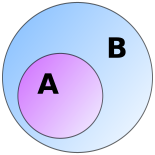
Venn Diagram: A Subset B: This Venn diagram illustrates the sample population within the larger, general population.
Another source of error stems from faulty demographic models past pollsters who weigh their samples by item variables such as party identification in an election. For example, i could assume that the breakdown of the United states of america population past party identification has not changed since the previous presidential election. As a issue, one would underestimate a victory or a defeat of a item party candidate that saw a surge or decline in its party registration relative to the previous presidential election cycle.
Theories on Erroneous Polling Results
A number of theories and mechanisms have been offered to explain erroneous polling results. Some of these reflect errors on the part of the pollsters; many of them are statistical in nature. Others blame the respondents for not giving candid answers (the controversial Bradley result & Shy Tory Factor).
Non-response Bias
Since some people practice not reply calls from strangers or pass up to respond the poll, poll samples may not exist representative samples from a population due to a not-response bias. Considering of this selection bias, the characteristics of those who agree to be interviewed may be markedly different from those who decline. That is, the actual sample is a biased version of the universe the pollster wants to clarify. In these cases, bias introduces new errors, in addition to errors caused by sample size. Mistake due to bias does not become smaller with larger sample sizes–taking a larger sample size simply repeats the same fault on a larger calibration.
Response Bias
Surveys may exist affected past response bias, where the answers given past respondents do not reverberate their truthful beliefs. This may be deliberately engineered by unscrupulous pollsters in order to generate a sure result or please their clients, but more than oftentimes is a event of the detailed wording or ordering of questions. Respondents may deliberately try to manipulate the outcome of a poll by advocating a more than extreme position than they actually hold in guild to boost their side of the argument or give rapid and ill-considered answers in club to hasten the cease of their questioning. Respondents may also feel under social pressure not to give an unpopular answer. In American political parlance, this phenomenon is oft referred to as the Bradley effect. If the results of surveys are widely publicized this effect may exist magnified in a phenomenon commonly referred to as the spiral of silence.
Wording of Questions
It is well established that the wording of the questions, the social club in which they are asked, and the number and class of alternative answers offered can influence results of polls. For instance, the public is more likely to signal back up for a person who is described by the operator equally 1 of the "leading candidates. "
A common technique to command for this bias is to rotate the social club in which questions are asked. Many pollsters too split up-sample in that one of two unlike versions of a question are presented to one-half the respondents.
Coverage Bias
Another source of mistake is the utilize of samples that are non representative of the population equally a issue of the polling methodology. For example, telephone sampling has a born fault because in many times and places, those with telephones accept generally been richer than those without.
Selection Bias
Selection bias occurs when some units have a differing probability of pick that is unaccounted for by the researcher. For example, some households have multiple phone numbers making them more probable to exist selected in a telephone survey than households with only i phone number.
In statistics, self-option bias arises in any state of affairs in which individuals select themselves into a group, causing a biased sample with non-probability sampling. Information technology is commonly used to describe situations where the characteristics of the people which crusade them to select themselves in the group create abnormal or undesirable atmospheric condition in the grouping.
In that location may be a purposeful intent on the office of respondents leading to self-choice bias whereas other types of option bias may arise more inadvertently, possibly as the result of mistakes past those designing any given report.
Phone and Internet Polling
Internet and telephone polls are very useful as they are much cheaper than most other polls and are able to reach a wide population.
Learning Objectives
Identify the advantages and disadvantages of telephone and internet polling
Cardinal Takeaways
Key Points
- Probability samples of internet polls are highly affected past problems of non- coverage. Not all members of the general population have Internet. In addition, online survey invitations are distributed using eastward-mail service, but there are no e-mail directories of the general population.
- Online survey may be affected by non-response as response rates are generally low and vary extremely. Some may refuse participation, terminate surveys during the process, or non reply certain questions.
- Telephone interviewers encourage sample persons to reply, leading to higher response rates and interviewers may increase comprehension of questions by answering respondents' questions.
- In that location are some disadvantages to telephone polling such as interviewer bias, the fact it cannot exist used for not-sound information, and it is unreliable for consumer surveys in rural areas where phone density is low.
Key Terms
- Internet Polls: Cyberspace polls are becoming an essential research tool for a variety of research fields, including marketing and official statistics research. Spider web polls are faster, simpler, and cheaper than many other polling methods.
- Telephone Polling: Phone polling is too adequately cost efficient, depending on local phone call charge structure, which makes information technology good for large national (or international) sampling frames.
Internet polls
Online polls are becoming an essential enquiry tool for a variety of research fields, including marketing and official statistics enquiry.
Advantages of Internet Surveys
Spider web polls are faster, simpler, and cheaper than many other polling methods. Nevertheless, lower costs are not so straightforward in practice, as they are strongly interconnected to errors. Because response rate comparisons to other survey modes are usually not favorable for online surveys, efforts to achieve a higher response rate may essentially increase costs. Additionally, the entire data collection menstruum is significantly shortened, as all data tin exist collected and processed in typically picayune more than than a month.
Interaction between the respondent and the questionnaire is also more dynamic compared to electronic mail or paper surveys. Online surveys are also less intrusive, and they suffer less from social desirability effects. Questions with long lists of answer choices can be used to provide firsthand coding of answers to certain questions that are usually asked in an open-concluded fashion in newspaper questionnaires. Finally, online surveys tin exist tailored to the situation (the questionnaire may exist preloaded with already bachelor information).
Methodological Issues of Online Surveys
Sampling
The deviation between probability samples (where the inclusion probabilities for all units of the target population is known in advance) and non-probability samples (which oft require less fourth dimension and endeavor but by and large do not back up statistical inference) is crucial. Probability samples are highly affected by problems of non-coverage (not all members of the full general population have Internet admission) and frame problems (online survey invitations are most conveniently distributed using east-mail service, only there are no e-mail directories of the general population that might exist used every bit a sampling frame). Because coverage and frame problems can significantly bear upon data quality, they should exist adequately reported when disseminating the research results.
Invitations to Online Surveys
Due to the lack of sampling frames, many online survey invitations are published in the grade of an URL link on spider web sites or in other media, which leads to sample pick bias that is out of enquiry control and to non-probability samples. Traditional solicitation modes, such every bit phone or mail invitations to spider web surveys, can aid overcoming probability sampling problems in online surveys. Nonetheless, such approaches are faced with problems of dramatically higher costs and questionable effectiveness.
Non-response
Online survey response rates are generally low and also vary extremely. In addition to refusing participation, terminating surveying during the process, or not answering certain questions, several other non-response patterns can be observed in online surveys, such as lurking respondents and a combination of partial and item not-response. Response rates can exist increased past offer monetary or some other type of incentive to the respondents, by contacting respondents several times, and past keeping the questionnaire difficulty as low as possible.
Questionnaire Design
The use of blueprint features should exist limited to the extent necessary for respondents to understand questions or to stimulate the response. The features should non affect their response as that would mean lower validity and reliability of data.
Information technology is important that uncontrolled variations in how a questionnaire appears are minimized. Web-based survey methods make the construction and delivery of questionnaire instruments relatively easy, merely what is difficult to ensure is that everyone sees the questionnaire as its designer intended it to be. This problem can arise due to the variability of software and hardware used by respondents.
Telephone Polling
An important aspect of telephone polling is the employ of interviewers. Interviewers encourage sample persons to answer, leading to higher response rates and interviewers may increase comprehension of questions by answering respondents' questions.
Telephone polling is also fairly cost efficient, depending on local telephone call charge structure, which makes it good for large national (or international) sampling frames.
Withal, there are some disadvantages to phone polling. For instance, in that location is some potential for interviewer bias (e.thousand. some people may be more than willing to talk over a sensitive event with a female person interviewer than with a male ane), telephone polling cannot be used for non-sound information (graphics, demonstrations, taste/smell samples), and it is unreliable for consumer surveys in rural areas where phone density is depression.

Number of fixed telephone lines globally: This chart shows the numbers of stock-still telephone lines from 1997 to 2007.
There are 3 main types of phone polling: traditional phone interviews, estimator assisted telephone dialing, and figurer assisted phone interviewing ( CATI ).
Source: https://courses.lumenlearning.com/boundless-politicalscience/chapter/measuring-public-opinion/
0 Response to "what techniques are used to obtain an accurate reading of public opinion"
Post a Comment